Five to six hundred socialists paraded through Montréal, and stopped in front of a university.
Jacques Rouillard, writing on working-class political action between 1899 and 1915, gives the scene in one paragraph. It is worth having in the original, because the draft versions of this story tend to soften it.
Cinq à six cents socialistes fêtaient le 1er mai en paradant dans les rues de la ville. Rendus en face de l’université Laval, un certain nombre d’entre eux se mirent à crier à pleins poumons : « À bas la calotte » ; « Vive l’anarchie ». Messieurs Dorman et Albert Saint-Martin avaient organisé cette manifestation. Jacques Rouillard · L’action politique ouvrière, 1899–1915
Down with the clergy. Long live anarchy. They marched behind a red banner lettered in white — Travailleurs du monde, unissons-nous ! — and Saint-Martin told the crowd that this flag would break the irons of the oppressed and destroy the tyrants.
Two things about that date. It is eleven years before the Russian Revolution, which means Québec’s confrontation with anarchism, socialism and anticlericalism cannot be filed as a reaction to Bolshevism. Bolshevism had not happened. And the university in question is Laval’s Montréal branch on rue Saint-Denis, not the campus in Québec City — a detail Francis Dupuis-Déri supplies, along with a second count of the crowd.
« Cinq à six cents socialistes ». Organised, he writes, by Dorman and Saint-Martin.
« entre 500 et 1 000 personnes », and he credits the organising to two bodies rather than two men.
That second attribution is the one this page will come back to. Dupuis-Déri writes that the first May Day in Montréal was « du travail conjoint du Mutual Aid Group et du Parti socialiste du Canada » — the joint work of the Mutual Aid Group and the Socialist Party of Canada. The Mutual Aid Group was a Yiddish-speaking anarchist network on Saint-Laurent, with a library founded in 1903, two bookshops, and a reading public of garment workers. Quoting Israël Medresh, he adds that the older radicals remembered the organising of Montréal’s May Day parades as anarchist work.
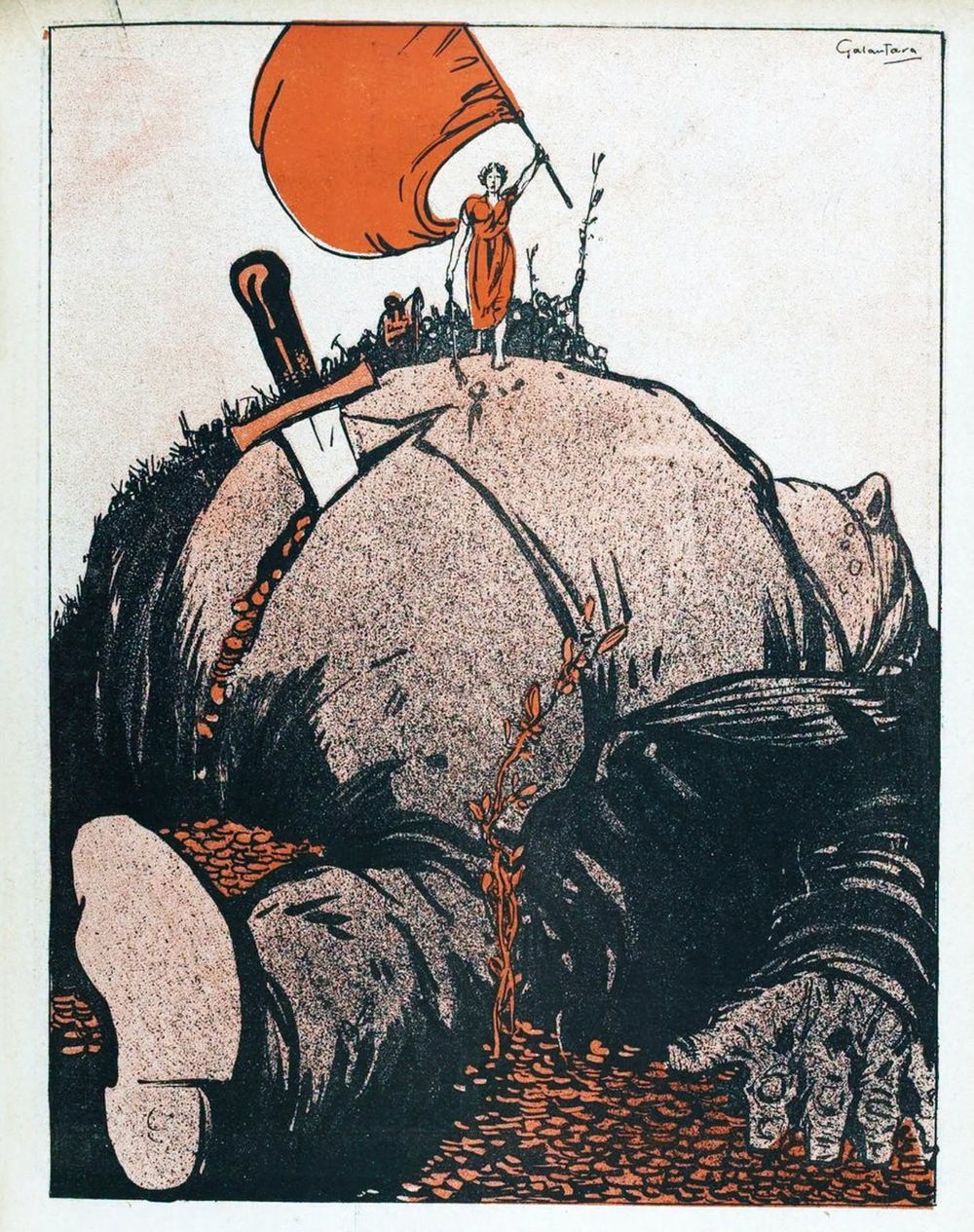
The reply did not come from the state. It came from a pulpit, and then from a horse.
The 1906 parade produced exactly the reaction it was designed to produce. Rouillard records that it drew the condemnation of the newspapers and the thunder of Archbishop Bruchési, and that when May 1907 approached, the city began preparing for it in advance.
In the days before 1 May 1907, Bruchési read a letter himself, in the cathedral, asking Catholic workers to stay away. He defended the right of property as « une des bases sur laquelle la société repose » — one of the bases on which society rests — and said that to follow that flag was to rise against what guarantees public order and peace.
Pressure was applied at city hall to ban the parade outright. Laval’s own students petitioned the council to that effect. When it went ahead anyway, dozens of them staged a counter-demonstration and attacked the rally massed at the Champ de Mars, which mounted police then dispersed.
Organisation
Neither side was arguing for disorder. The Church had parishes, schools, hospitals, confessional unions and a daily paper. The socialists had unions, cooperatives, mutual aid networks, a publishing operation and a parade.
Where legitimate authority lives
Whether order descends from a source above the participants, or is constituted by the participants themselves. That question is older than both of them and it did not get settled in 1907.
A free, compulsory, secular school was filed as a principal cause of anarchism.
Richard Jones spent a study on two years of a single newspaper. L’Action catholique ran about 20,150 subscribers in March 1920 and climbed past 22,700 by October. Its editorial bench included Jules Dorion, the abbés Nadeau and Lavergne, J.-Albert Foisy, and — signing occasionally — Mgr Louis-Adolphe Paquet, dean of theology at Laval.
On education, the paper printed the chain of reasoning outright. Free compulsory secular schooling was a set of fumisteries hiding « l’école sans Dieu » behind the pomp of its adjectives. Then, in two consecutive sentences:
Voilà une des principales causes du mouvement anarchique et du bolchevisme. Voilà une preuve de plus de l’activité fébrile de la maçonnerie. L’Action catholique, quoted in Richard Jones, 1974
There is the whole method in twenty-two words. A school policy is not argued with as a school policy. It is converted into evidence of two other things, one of which is a conspiracy. The paper’s own remedy was as specific as its arithmetic: it would denounce compulsory schooling and refuse to place in the hands of the 6,636 Freemasons of the Province of Québec the means of de-Christianising the people.
The point is not that the paper had enemies. It is that the enemies were collapsed into one enemy. Tap any term below and watch where it arrives.
Pick a term.
Six different things — a school statute, a fraternal order, an economic doctrine, a foreign government, a philosophy, and a population — resolve to one destination. That compression is not incidental to the history. It is the history.
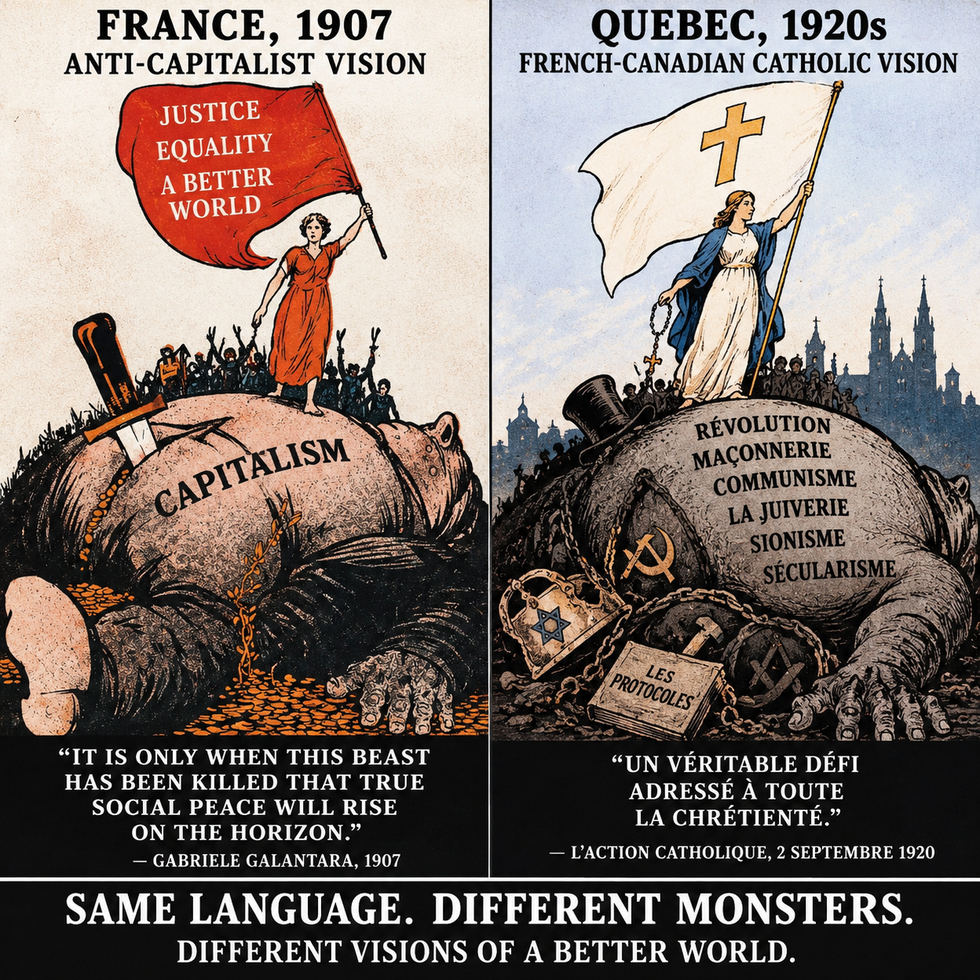
Jones gives the structure its period name. L’infâme trinité.
His chapter on the subject is titled Trois mythes, and it is blunt about what it is describing: « Le franc-maçon, le Juif et le bolcheviste étaient tous au centre de mythes. » According to those myths the three groups — often held to be working together, being so closely linked — spent their time plotting against the natural order, against Christian society, and against humanity in general.
The compound term judéo-maçonnerie became, in Jones’s phrase, monnaie courante — common currency. In Hungary it was the « judéo-maçons » plotting tomorrow’s atrocities. Foisy wrote that the Jewish element « constitue un ferment révolutionnaire terrible » and that it had to be crushed.
And the Protocols of the Elders of Zion arrived in exactly this period. Jones states their status in the same breath as their reception — they were quickly recognised as a fraud perpetrated by the tsarist secret police. That did not settle the question at the paper. Foisy, having received the text, wrote:
Si ce n’est pas l’exposé d’un plan ourdi d’avance, c’est une prophétie remarquable. J.-Albert Foisy · L’Action catholique
It was not a synonym for disorder. It named a chain reaction.
Mgr Paquet ran a long editorial series on Bolshevism, and his definition is the most useful sentence in the whole corpus for understanding what the word was doing. Bolshevism, he wrote, was adequately explained by « un formidable synonyme que nous avions déjà : l’anarchie ». And then, precisely:
L’idée bolchéviste peut se définir comme le renversement de l’ordre social et de toutes les institutions par tous les moyens, sans excepter la violence. Mgr Louis-Adolphe Paquet · L’Action catholique
Toutes les institutions. Not the government. Not the owners. All of them, as a single object. That is why the word could be applied to a schoolteacher and a bomb-thrower without the paper feeling it had changed subjects — and why Dorion could write that Protestantism’s private judgement was « l’anarchie dans la croyance », anarchy in belief. Anarchy was whatever loosened a rung.
This also explains why a secular school kept appearing next to bomb-throwers on the same list. A school without a chaplain is not socialist. But it is a demonstration that a major institution can be built, staffed and run outside ecclesiastical control — which is the premise, not the conclusion, that the whole structure could not survive.
Denouncing socialism did not fix a dangerous factory. So the Church built unions.
Industrial Québec in 1920 produced problems that editorials could not reach. Prices had run away — a week’s food for a family of five cost $16.65 in May 1920 against $4.78 in May 1914. By September the paper was reporting 25,000 unemployed in Montréal and forecasting 40,000 by winter. American internationals were organising, and about 35,000 workers had already grouped into confessional and national unions.
L’Action catholique was warm about the latter and hostile to the former. Catholic unions, it wrote, were a safeguard of order and property — « une digue contre les vagues mugissantes du socialisme accapareur et de l’anarchie niveleuse », a dyke against the roaring waves of grasping socialism and levelling anarchy.
It worked, and there is a measurement. Dupuis-Déri, tracking the Industrial Workers of the World branch founded in Montréal in 1905 after French CGT delegates had addressed three hundred people on direct action the year before, records the outcome in a single clause: « la mise sur pied de syndicats catholiques freine la progression de ce syndicat ». Setting up Catholic unions slowed the revolutionary union down. It never recruited significantly outside the immigrant worker communities.
Then, at Hull, the confederation. Two sources count the founding congress differently, and both are printed here because neither is wrong about itself.
« En septembre 1921, quatre-vingt-huit syndicats catholiques participèrent à la fondation » — and he dates it to September.
« En 1921, à Hull, 220 travailleuses et travailleurs, représentant 80 syndicats » — delegates and unions, no month given.
The Confédération des travailleurs catholiques du Canada was, on the day it was founded, two or three times smaller than the Trades and Labour Congress it was built to compete with. That is not the interesting fact about it.
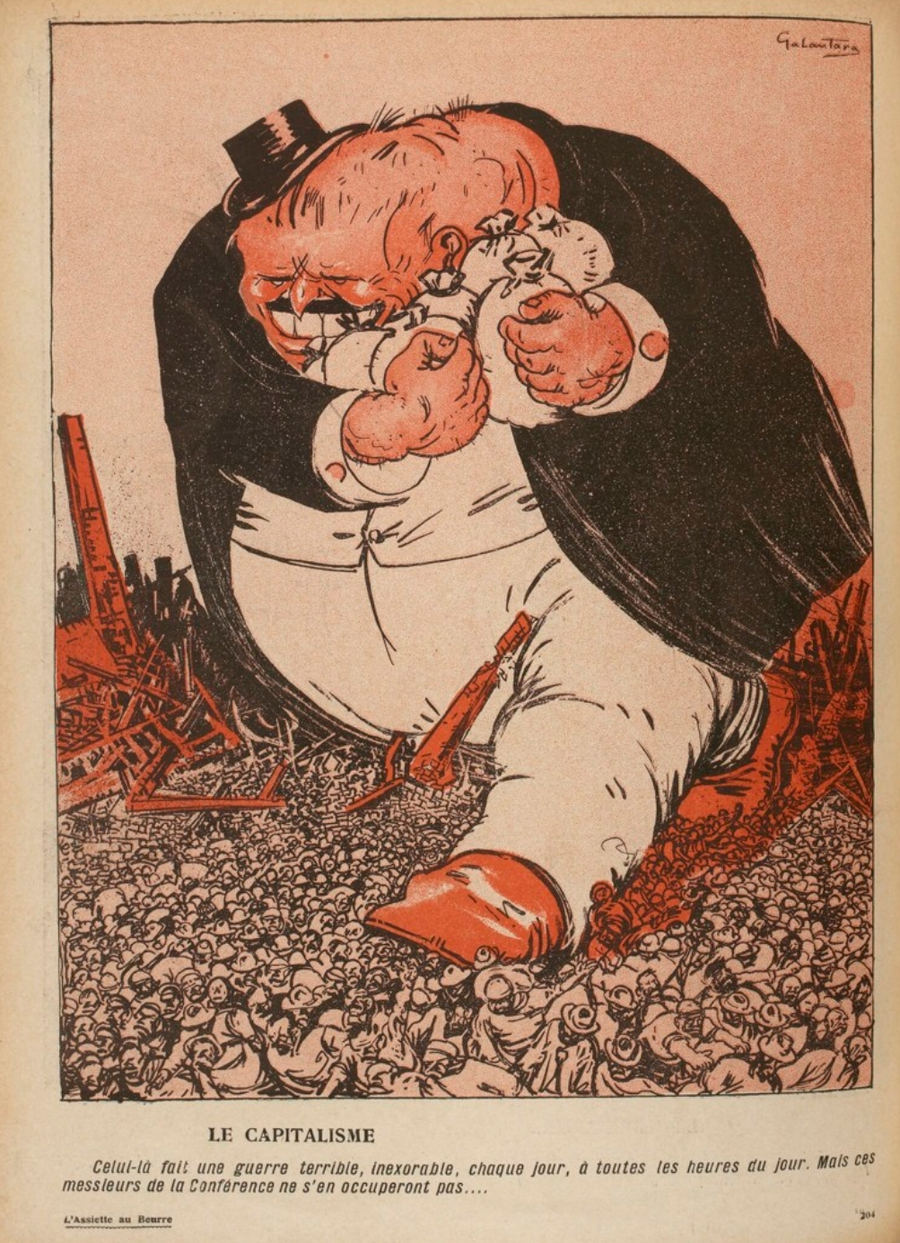
A union built to preserve the social order is still a union.
Jones calls the paper’s position on strikes un peu équivoque, which is generous. Foisy conceded the principle in an editorial, and the wording is precise enough to be load-bearing:
Il était incontestable que les ouvriers ont le droit de faire la grève quand il n’y a pas d’autre moyen d’obtenir la justice. J.-Albert Foisy · L’Action catholique
He immediately hedged it with the horror many workers felt at the prospect. But the concession had already been made, in print, by the institution that existed to prevent exactly this: that there are conditions under which withholding labour together is legitimate. Once that is conceded, the argument is no longer about whether workers may combine. It is about when.
And the machinery required to answer when is the machinery of a labour movement. Dues. Delegates. A congress. Bargaining committees. A strike fund. The organisational technology does not carry the theology that installed it.
Hold the line
Keep French-Canadian Catholic workers out of American internationals, out of the IWW, and inside a structure where the chaplain sat at the table.
Teach the method
Combination, collective demand, collective bargaining, and the capacity to stop. Skills that do not un-learn when the chaplain leaves.
In 1960 the CTCC deconfessionalised and became the Confédération des syndicats nationaux. The CSN’s own account of what its work then became lists wages, job security and pensions — and then keeps going, to dangerous conditions, discriminations of every kind, work rates, and la hiérarchie.
The institution survived. Its theological enclosure did not. To contain independent worker power, Catholic Québec helped institutionalise worker power — and institutionalised worker power went and acquired capacities of its own.
The other answer was not refuted. It was padlocked.
Saint-Martin is the figure this story keeps returning to, and the usual summary of him — agitator, parade organiser, perennial losing candidate — misses what he actually spent his life doing, which was building institutions. The Ville de Montréal’s note on the park that carries his name lists an Esperanto cooperative, a publishing cooperative, and a workers’ university.
That last one has a cause, and it is not the one usually given. Dupuis-Déri records that Moscow and the Communist International refused to recognise a French-Canadian communist party autonomous from the Canadian Workers’ Party. Saint-Martin — whom Tim Buck labelled a nationaliste and an anarcho-communiste — broke away, and in 1925 founded the Université ouvrière.
For ten years it was a refuge for a mixed crowd of anarchists and revolutionaries who wanted nothing to do with Bolshevism: the free-thinker Gaston Pilon, the French anarchist Paul Faure, lectures on subjects including Sébastien Faure’s Les 12 preuves de l’inexistence de Dieu, which was popular for reasons that had little to do with France. After the 1929 crash, two anticlerical militants connected to it, the brothers Abel and Émile Godin, launched the Association humanitaire — thousands of members inside a short time, described by the communist Dorothy Livesay as an anarchist group led by Saint-Martin, and engaged in direct action and occupations against evictions.
It did not lose an argument. Catholic youth attacked its members and burned the books of its public library in the street. And in 1937, Maurice Duplessis’s Act to Protect the Province Against Communistic Propaganda — the Padlock Act — gave the attorney general the power to close a building for a year on suspicion, and to seize and destroy what was printed inside it. The name is literal. They put a padlock on the door.
Read the two endings side by side. The confessional union was absorbed and outlived its theology. The workers’ university was burned and then legislated shut. Only one of those is a refutation, and it is not the one that used an argument.
The parade that started all of this was not organised by the people the history remembers.
Go back to the first of May, nineteen oh six, and look at who was actually in the street. Rouillard names Dorman and Saint-Martin. Dupuis-Déri names two organisations, and the second one has no place in any of the accounts that followed.
Yiddish-speaking anarchists in Montréal. A library founded in 1903. A discussion circle, a mutual aid network, and a bookshop on Saint-Laurent selling revolutionary papers written for North American workers in Yiddish. A second bookshop after the failed Russian revolution of 1905 brought more of them. A branch of the Arbayter Ring in 1906.
In 1908 they brought Emma Goldman to the Bourse du travail to lecture in English — deliberately, to build a bridge to the rest of the city. Goldman’s own line on the reaction: without these creatures, Canada would go on being dull, pious and stupid.
They co-organised the first May Day parade in Montréal. The one that shouted Vive l’anarchie in front of Laval.
So the newspaper was printing la Juiverie on a list of things menacing Christian order in Québec — while the actual Jewish radicals of Montréal were the people who had put the confrontation in the street in the first place. Both facts belong to the same city and the same decade.
And the failure was not only the newspaper’s. Dupuis-Déri is direct about what the French-speaking libertarians did with their attention: fixed on breaking the grip of the clergy, they paid little mind to what was happening in the immigrant communities a few streets over.
Deux solitudes cohabitent, se croisent, mais ne parviennent pas à faire cause commune. Francis Dupuis-Déri · Pistes pour une histoire de l’anarchisme au Québec
Two solitudes live side by side, cross paths, and never manage to make common cause. That is the sentence the whole period turns on. The threat-list did the compressing from above; the movement did the ignoring from within. A population ends up as a term on a list either way.
Which returns the file to its question. Who gets to constitute order?
The Catholic argument was that removing a rung removes the ladder — that without a permanent centre of command there is no coordination, only anarchy in the sense of rubble. Everything above is evidence against that, and a good deal of it was built by people the record barely names.
The disagreement was never organisation against chaos. It was hierarchical organisation against associational organisation — and one side of it had to be shut by statute.
Expertise is not rule. Coordination is not command. Delegation is not sovereignty. Somebody may have to know, coordinate, communicate or perform; none of those logically requires somebody to rule. That is the bridge from an unfinished revolution in Québec to everything else in this series.
The question of authority never goes away. It only changes which institution is holding it.
Every quotation above is from one of these, in the language it was printed in.
- The Federation, File №05 — The Colossus. Why the usurper is obeyed at all. This file is what happens when the answer is organised and then made illegal.
- The Federation, File №07 — The Quiet Yes. Obedience as a supply delivered from below. The CTCC is a case study in what happens when you teach people to notice the delivery.
- The Federation — The Crime of Meeting. Criminalising association. The Padlock Act is the same instrument with a different year on it.
A population became a term on a list. The question of authority never goes away.